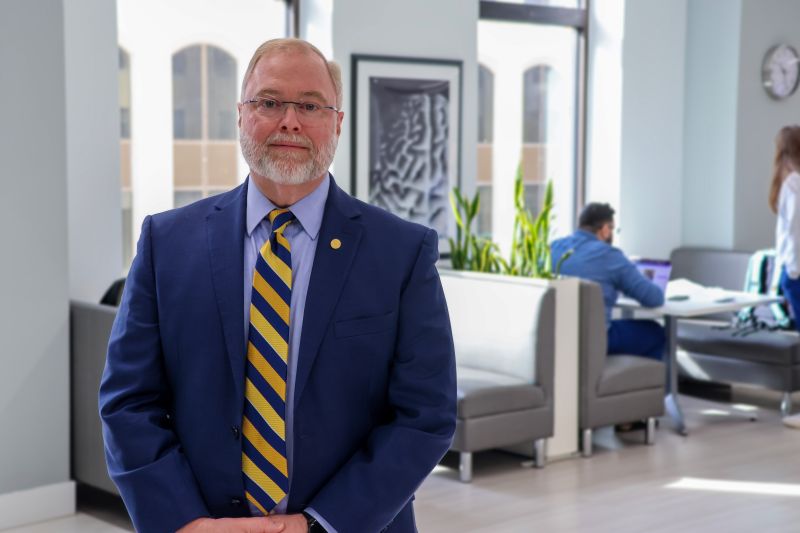
There is a calm precision to the way Eric Gish, DO, listens; a habit honed through decades of practicing osteopathic manipulative medicine (OMM), where connection and attentiveness guide every interaction. His relational mindset shapes his style of leadership at the Kansas College of Osteopathic Medicine.
When Dr. Gish assumed the role of dean in late 2025, he named two priorities. First is securing accreditation through the Commission on Osteopathic College Accreditation (COCA), a requirement for all new osteopathic medical schools. COCA accreditation affirms the quality of the program, ensures student doctors can complete their degrees and enter residency, and confirms that KansasCOM meets national standards for osteopathic medical education.
Strengthening a unified culture is his second priority. Unity, he says, supports other key objectives: enhancing academic quality, supporting faculty as curricula evolve, and broadening mentorship for student doctors.
“We need to have unity, but that doesn’t mean uniformity,” Dr. Gish says. “We don’t all have to think alike or be alike, but we do have to be in the same mind, purpose, and direction, and work toward the same goals.”
As dean, Dr. Gish works closely with Ronnie Martin, DO, who serves as Vice President of Academic Affairs for Kansas Health Science University, to guide the institution through the final stages of accreditation and coordinate academic strategy across programs.
Keeping students at the center of those decisions, Dr. Gish aims to continue improving KansasCOM’s educational framework through meaningful, relationship-driven work, a philosophy he has shaped over 18 years of leadership in osteopathic education.
Building Programs by Building Relationships
Dr. Gish brings deep experience in osteopathic medical education. After years in private practice specializing in family medicine as well as osteopathic neuromusculoskeletal medicine, he helped establish two osteopathic medical schools.
He served as founding Chair of the Department of OMM at Rocky Vista University College of Osteopathic Medicine (RVUCOM) and later as founding Associate Dean for Clinical Affairs at Liberty University College of Osteopathic Medicine (LUCOM). In those roles, he helped design full curricular systems, including a seven-campus clinical network spanning three states. Working across teams and building a strong, intentional culture were key to keeping his approach focused on people.
Most recently, he served at Campbell University School of Osteopathic Medicine as Associate Dean for OMM Integration, giving him a view into the expectations, cadences, and demands of mature osteopathic programs. He has also contributed to national osteopathic policy and standards through health policy fellowship training, board service, and committee roles across multiple professional organizations.
Building KansasCOM’s future and opportunities to serve the community, Dr. Gish says, requires sustained engagement with the community and the region it serves.
As part of Wichita’s growing biomedical corridor, KHSU continues to build strategic partnerships that advance health sciences education and drive collaboration with health care providers and emerging initiatives downtown. Yet, what excites him most is the impact KansasCOM graduates will have across Kansas.
“It’s amazing to think of how many doctors we’re going to graduate, and hopefully they’ll get out in these areas that are in most need and start meeting the health care needs of patients right here,” Dr. Gish says.
As KansasCOM advances efforts toward accreditation and its first graduation, Dr. Gish keeps the focus on people: student doctors, faculty, and the patient populations they will impact.
“First of all, I hope students know they are important and valued here,” Dr. Gish says. “Medical school is hard enough; we don’t need to add to that. Our job is to support them, mentor them toward their goals, and prepare them academically and professionally. When they leave here, I want them to say, ‘It was tough, but KansasCOM helped me through it.’”
To Dr. Gish, the real measure of KansasCOM’s work will be reflected in the physicians it prepares and the communities they choose to serve. When students carry their training into the underserved regions, he sees the school’s mission accomplished in meaningful ways. His leadership, supported by committed educators across KansasCOM, helps ensure that an emphasis on human connection and attentive care guides the next generation.