
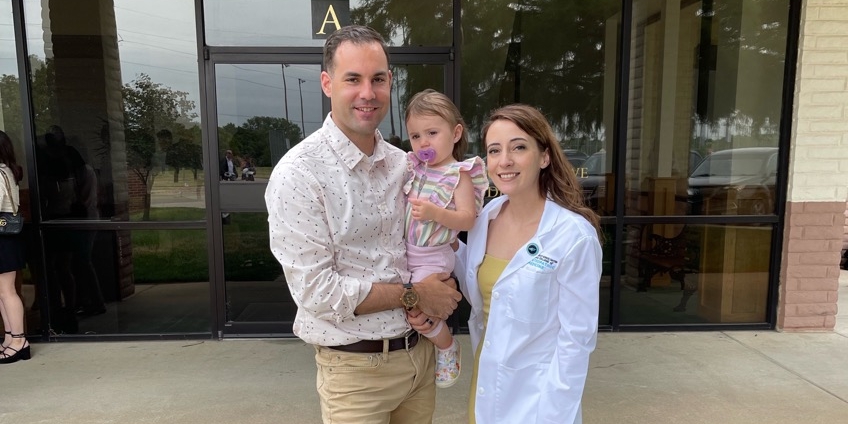
Kelsey Schmittling never planned to become a doctor. After years away from the classroom, she found her path to medicine while raising a family and preparing for a career in pathology.
Kelsey Schmittling didn’t leave college looking like a future physician. She had struggled as an undergraduate, had no interest in becoming a doctor, and spent several years working in research without feeling that she had found her path. What changed her course was not a single revelation but a willingness to take risks. The first was enlisting in the Army National Guard at 27. “That started a cascade of trying things and not being afraid to fail,” she says.
The second important risk Schmittling took was in applying to a program to become a pathologist’s assistant. She was accepted but was unable to enroll due to a conflict with her military training. Still, the acceptance planted an idea in her head: “If I can get into pathologists’ assistant school, maybe I can go to medical school and become a pathologist.”
Thinking that it was a long shot, Schmittling applied to medical schools, focusing on those in the Midwest where she and her husband both grew up. She interviewed at a few colleges of osteopathic medicine but found the experience at KansasCOM far superior to the others.
“It was just wonderful, and everybody was so welcoming,” Schmittling says. Her sense of belonging deepened once she arrived for Accepted Students Day, assuaging any nervousness she still felt about whether she had made the right choice. She says, “When we left that day, I thought, ‘This is where I want to be.’”
Compounding the rigors of medical school was the fact that Schmittling was entering the classroom for the first time in more than 10 years after a lackluster undergraduate career. Plus, she was doing so as the mother of a young daughter, and with her husband away in the Army. The couple were to have two more children by the time Schmittling graduated.
Schmittling’s obstacles were real, but she didn’t lack support. The sense of belonging and kinship she felt when she arrived st KansasCOM extended to the faculty as well. “Our faculty and staff felt like friends,” she says. “They were our professors, and we had a professional relationship, but a lot of them meant so much more to us.”
Schmittling especially valued the support of Shannon Curran, who was the director of the anatomy laboratory. Schmittling was always up front about the demands of her family life, with limited options for day care. During Schmittling’s first two years, Curran’s office became a safe space for Schmittling and her daughter alike.
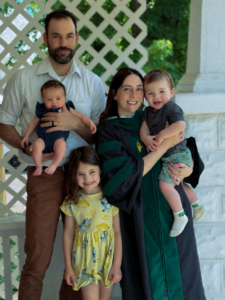
Kelsey Schmittling and family at KansasCOM graduation.
Schmittling was also fortunate in her preceptors, as she had to balance childcare with her internships and clerkships all around Kansas, including a psychiatry internship that entailed a three-and-a-half-hour round trip to and from Great Bend.
Sadly, Shannon Curran died in Nov. 2025, at a time when students were away from campus and couldn’t come together to grieve. “Graduation was difficult,” Schmittling says. “One of the last conversations I’d had with her was when she agreed to be my ‘hooder’ at graduation. There were a lot of tears that day.”
Schmittling attended Match Day a week after giving birth to her third child and was placed in the pathology department at SUNY Upstate Medical University in Syracuse, New York. Just as she envisioned, she’s become the pathologist rather than the assistant. For the future, she’s interested in becoming a medical examiner.
With three children at home and an exciting medical career ahead of her, Schmittling is reaping the rewards of her unconventional path. In retrospect, she sees the challenge of balancing her home life with medical school as paying dividends. “Having something outside of medical school and medicine was really a benefit to me,” she says. That perspective may prove to be one of the most valuable things she takes with her into residency.