
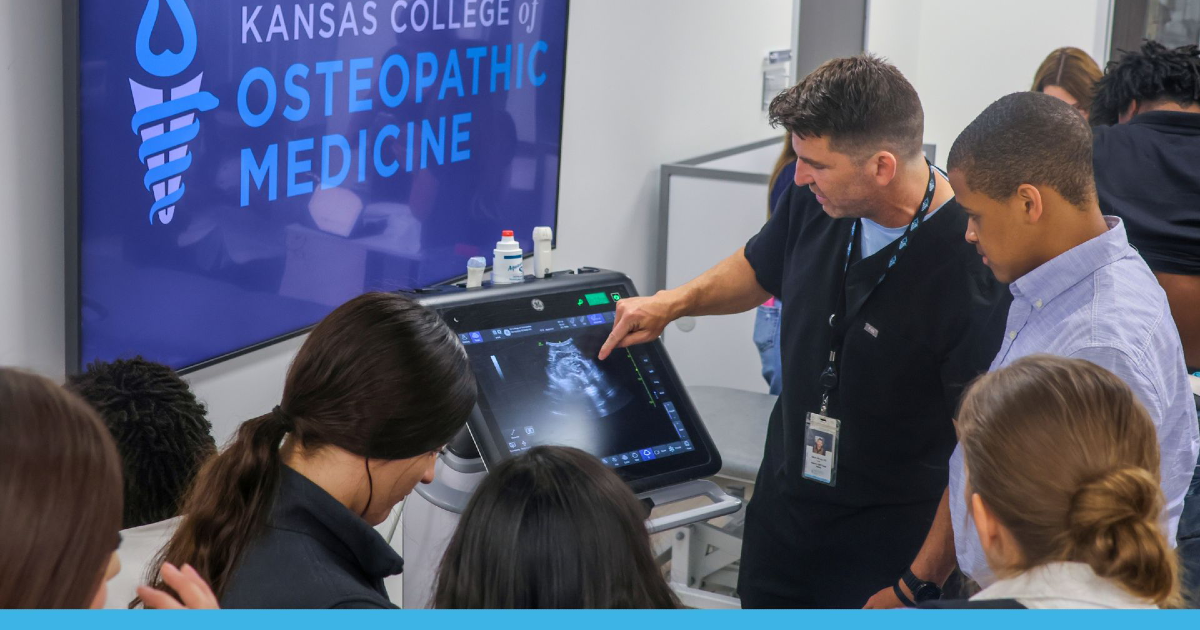
From the College World Series to rural Kansas, students explore pathways into team-based care.
Like many student-athletes, Nicole Terpack’s interest in sports medicine began with an injury. Hers kept her sidelined for more than a year.
Originally from New Jersey, the second-year student doctor is now president of the Student American Osteopathic Academy of Sports Medicine chapter (or “Sports Medicine Club”) at KansasCOM.
“I played sports my whole life. I powerlifted throughout college and had my own accident where I ended up getting post-concussion syndrome,” she says. “I worked with a primary care sports medicine physician, and I was like, ‘I want to be you.’”
Now, Terpack plans to pursue either family medicine or physical medicine and rehabilitation followed by a sports medicine fellowship, pathways she says many don’t realize exist.
She shared this story with a lecture hall of high school and college students from across Kansas at the fourth annual Sports Medicine for Students Symposium at Kansas Health Science University, an event designed to inspire the next generation of healthcare professionals by illuminating some of those lesser-known pathways.
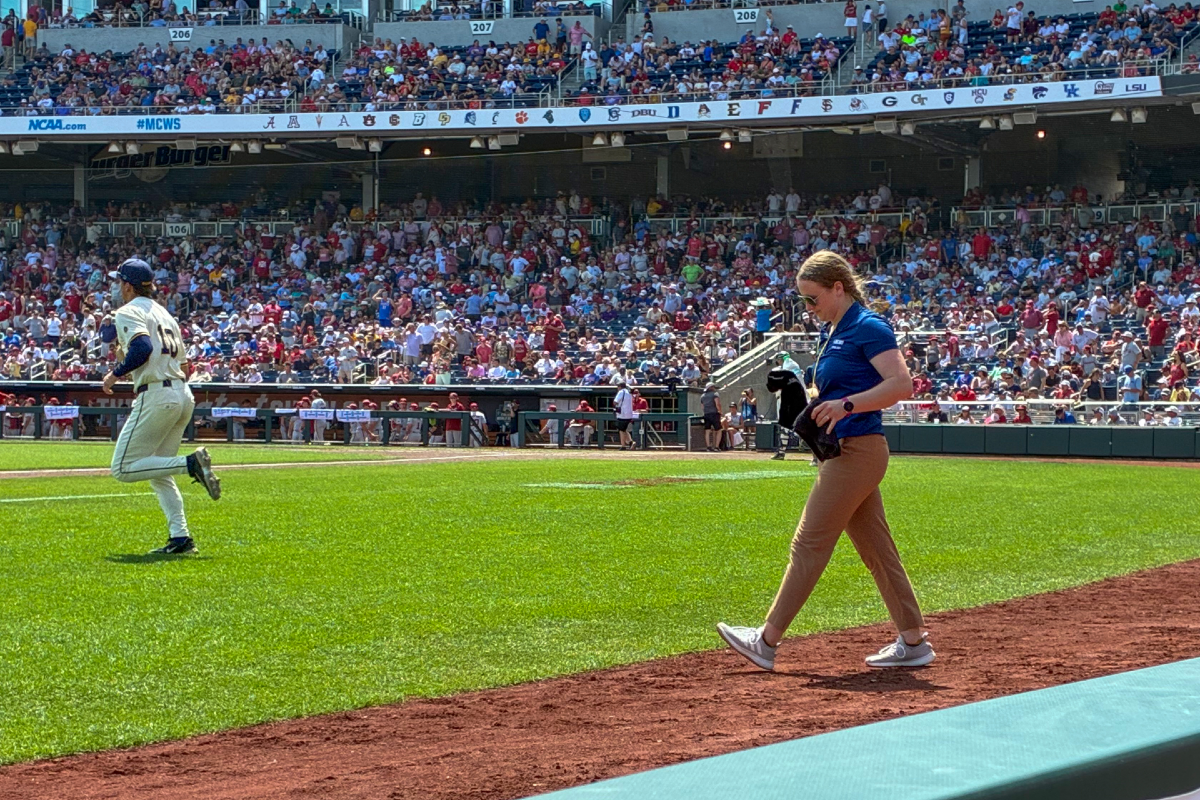
Nicole Terpack walks onto the field at the College World Series as part of a KansasCOM student learning experience.
Alongside three KansasCOM classmates, she also recounted her experience shadowing team physicians at the College World Series last year with Joaquin Santos, MD, a longtime sports medicine physician and clinical faculty member at KansasCOM.
Seeing Medicine as a Team Sport
On the field in Omaha, one lesson stood out: practicing medicine looks a lot like playing on a team.
At the College World Series, students didn’t just observe physicians. They saw an entire care ecosystem in motion. When a player came off the field with a potential injury, athletic trainers evaluated him within seconds while physicians stepped in to guide next steps, and EMS stood ready if escalation was needed. Physical therapists, nurses, and support staff worked in sync to deliver care in real time.
For nearly 40 years, Dr. Santos has provided medical support at the College World Series, bringing students into the dugout to learn firsthand. What they encounter on these medical teams isn’t hierarchy but more like a well-rehearsed play. It also becomes clear that care is not limited to elite athletes. Crowds can reach 30,000, and many fans require treatment for heat illness, dehydration, and alcohol-related issues.
James Joseph, MD, senior associate dean for Clinical Education, designs the symposium each year to reflect this broad, interprofessional landscape.
“Historically, sports medicine has really been for orthopedic surgeons like me,” Dr. Joseph says. “But nowadays, the sports world is such a big place. It is a million-dollar industry.”
The symposium’s presenter lineup reflects how wide the field of athlete care has become. Speakers include a professional athletic trainer working at the highest level of minor league hockey with the Wichita Thunder, a licensed clinical professional counselor supporting athletes’ mental health, a registered dietitian specializing in performance nutrition, and a physician focused on injury prevention and environmental health in sport. Each represents a different entry point into the field and a different way for students to see themselves within it.
KHSU connects these diverse pathways into medicine to Kansas’ growing need for healthcare providers. In many rural communities, Dr. Santos notes, physicians do not work in silos. Instead, they serve as the backbone of care, often stepping into multiple roles, including treating student-athletes.
“Particularly in those rural communities, they will be the team physician for their high school,” he says. “And it is very important for small towns to have a fully staffed medical community caring for their student-athletes.”
The symposium helps students understand that sports medicine is not limited to collegiate play or major leagues. More often, it takes shape under Friday night lights or in small-town schools.
Seeing Possibility Up Close
One of the most powerful elements of the event is simply proximity.
KansasCOM students and faculty guided visiting high school and undergraduate students through hands-on activities using tools such as HoloAnatomy and point-of-care ultrasound technology, offering a glimpse into how modern medicine is taught and practiced.
For educators like Rodrigo Carrizales of Salina Central High School, the experience reinforced what students are learning in the classroom.
“I teach medical science. It’s like an introduction to healthcare,” he says. “I also teach sports medicine and coordinate internships with hospitals for their senior year.”
Watching his group of students interact with holographic anatomy models, he added simply: “This is awesome.”
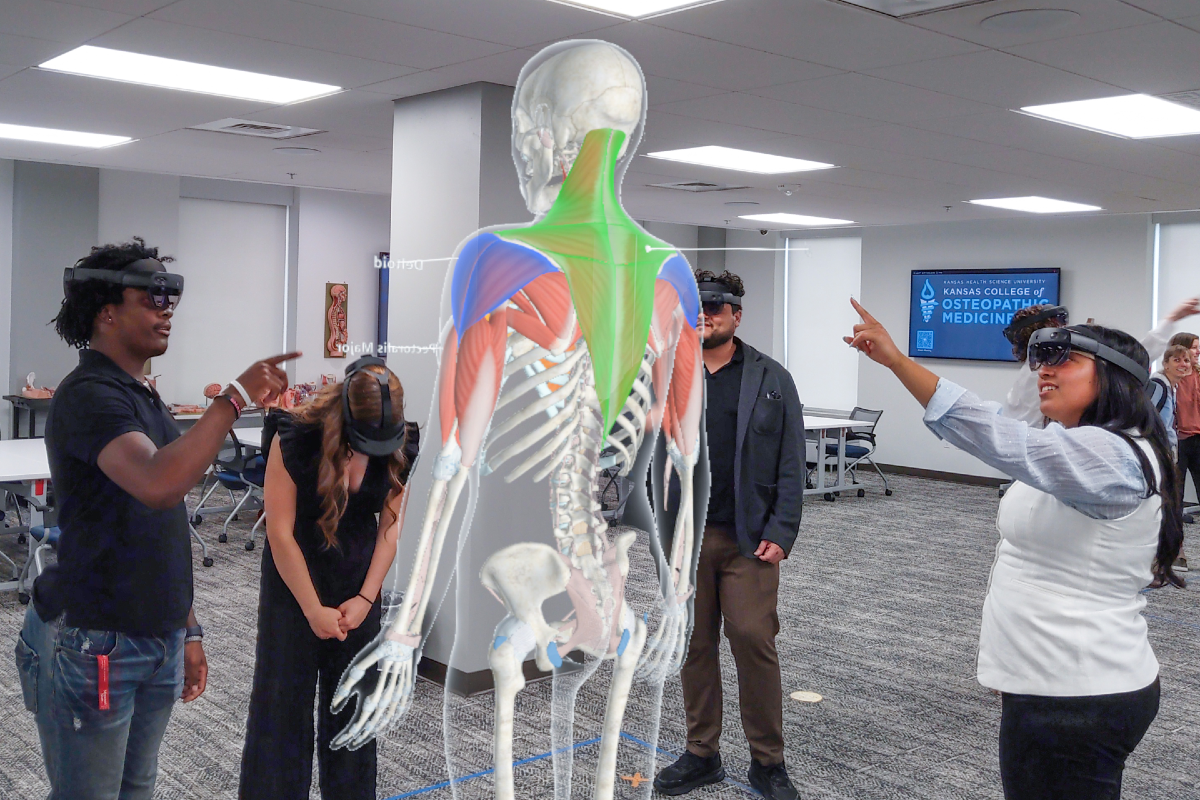
Rodrigo Carrizales and his students examine muscle groups using a holographic anatomy model at KansasCOM.
According to Terpack, speaking with younger students was a defining part of the day.
“Being able to talk to high schoolers specifically was really amazing,” she says. “It shows them what’s after high school and what could be possible after college.”
Moments like these make an intimidating field feel accessible.
She says, “I hope what they took away was that they can do anything they want to do.”
The Sports Medicine for Students Symposium is made possible through support from the Kansas Leadership Center and the Wichita Medical Research and Education Foundation. Their investment helps expand access, mentorship and hands-on learning opportunities for future healthcare professionals across Kansas.