
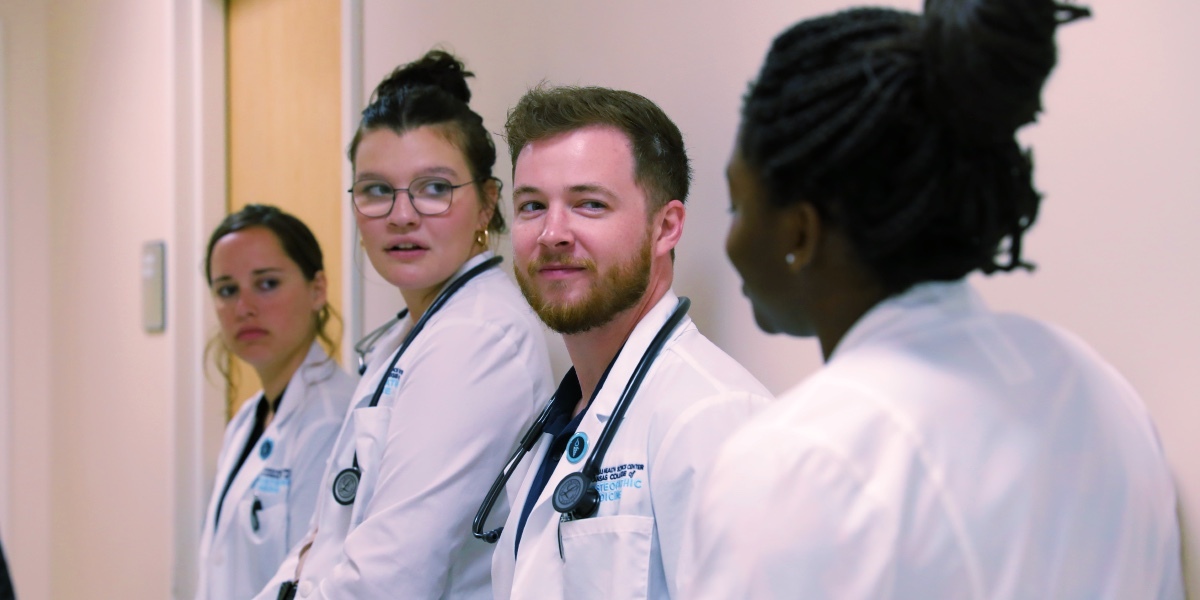
Known for its deep community roots, Wichita is becoming a national model for community-integrated medical education. At the center of that transformation is Kansas Health Science University’s Kansas College of Osteopathic Medicine (KansasCOM).
University’s Kansas College of Osteopathic Medicine (KansasCOM).
At KansasCOM, medical education isn’t confined to campus. It lives in every exam room and every community partnership. Here, future osteopathic physicians (DOs) gain real-world experience from the start, learning how to treat patients holistically, understand the broader challenges affecting community health, and develop the empathy and leadership they’ll need to serve in places that need them most.
Learn how KansasCOM is turning Wichita into a hands-on classroom to meet the health care needs of Kansas and beyond.
Why Wichita Is an Ideal Training Ground for Future DOs
Wichita offers future physicians both access to advanced health care systems and real opportunities to engage with underserved communities. This mix gives KansasCOM students broad clinical exposure that reflects the holistic approach of osteopathic medicine.
Wichita sits at the intersection of urban and rural health care needs, so KansasCOM students gain an understanding of the unique dynamics that affect patients across Kansas. With 85 counties in the state designated as medically underserved, KansasCOM’s choice to base its training in Wichita reflects a commitment to educating DOs where they’re most needed.
Benefits of Studying Medicine in Wichita
- Integrated health care networks: Students learn how systems collaborate by rotating across hospitals, clinics, and specialty centers, gaining insight into the flow of care between providers.
- Diverse patient populations: Wichita’s multicultural and economically varied communities expose students to a wide range of health conditions, communication styles, and social determinants of health.
- Proximity to rural and frontier regions: Just beyond city limits, students can experience rural medicine firsthand, helping them contrast and connect what they see in different environments.
- Breadth of specialties and sites: Students engage with everything from high-acuity surgery to long-term primary care, building a deep and adaptable foundation for future practice.
Real Experience From Day One
Diverse Clinical Rotations
KansasCOM’s clinical education model ensures students get real patient experience early and often. By their third year, students complete nine core clinical rotations, each four weeks long, working directly with patients and preceptors across Kansas.
With more than 350 preceptors and partnerships statewide, students rotate through diverse specialties, from pediatrics to surgery, in both large hospitals and small clinics. These rotations reinforce classroom learning and challenge students to apply their knowledge in high-stakes environments.
Skill-Building in Action
While clinical rotations are designed to build students’ core medical competencies, they also offer countless opportunities to step into real clinical environments and apply what they’ve learned in meaningful ways. KansasCOM’s model emphasizes direct engagement with patients and teams, not just observation.
KansasCOM student doctor Matthew Bevens recalled participating in a laparoscopic surgery during the end of his clinical rotation, supervised by the surgeon. “For me to be able to hold a gallbladder using an instrument and to make the incisions to take the gallbladder off—I don’t know if we could have gotten that experience anywhere else,” Bevens says.
In addition to clinical competencies, students also learn how to communicate with patients from various backgrounds, build trust quickly, and manage a wide range of health concerns with limited resources, especially in more rural settings.
Where Empathy Meets Education
Poverty Simulation and Holistic Care
Osteopathic medicine is rooted in holistic care, and KansasCOM brings that philosophy to life through immersive, empathy-driven experiences that prepare students to understand the full context of patient care. One of the most impactful examples of this training is the Community Action Poverty Simulation (CAPS), an exercise that underscores how socioeconomic barriers directly affect health outcomes.
The CAPS program is especially relevant in a city such as Wichita, where many residents face intersecting challenges such as housing instability, limited access to nutritious food, and gaps in transportation. These same issues often surface during clinical encounters, particularly in community clinics and safety-net health centers where KansasCOM students complete rotations.
During the simulation, students are assigned roles that mirror real-life scenarios, managing chronic illness on a low income, affording medications without insurance, or accessing care while juggling multiple jobs. These are not hypotheticals; they’re reflective of the lived experiences students encounter in Wichita’s diverse neighborhoods.
Through CAPS, students learn to:
- Recognize the cumulative stress of poverty and how it impacts physical and mental health
- Identify systemic barriers that prevent patients from accessing timely care
- Build deeper empathy and cultural humility that inform more compassionate treatment plans
- Reframe their clinical mindset to consider a patient’s broader life circumstances
“It was a very eye-opening experience,” KansasCOM student doctor Collin Garota said about participating in CAPS.. “It’s important to realize these realities when treating patients, to include their background in their treatment, and to be aware of getting them the resources they really need.”
By participating in simulations like CAPS and applying that perspective directly in Wichita’s clinics, students reinforce the idea that their classroom is the community and the community is their classroom.
Community-Based Research with KERN
As part of Wichita’s community-integrated learning environment, KansasCOM students take on research that tackles pressing health care questions across Kansas. They work alongside providers in the Kansas Educational Research Network (KERN), collaborating on community-based research projects that directly improve care in underserved areas.
These projects are tailored to the specific needs of local practices and patient populations, making them deeply relevant to students’ experiences in Wichita and throughout Kansas. The work often begins with a clinical question posed by a rural provider or health center that lacks the time or resources to investigate it themselves. Students then collaborate with mentors to design studies, collect data, and develop solutions with real clinical impact.
In this work, students can:
- Develop a patient education initiative to improve diabetes management outcomes
- Conduct workflow assessments to streamline care delivery in busy rural clinics
- Analyze data trends to help identify barriers to medication adherence
- Facilitate provider-patient communication tools to support behavioral health
This kind of collaborative, problem-solving experience deepens students’ understanding of how care is delivered and where the system can evolve. More importantly, it trains future DOs to approach medicine not only as clinicians but also as community-informed problem-solvers, a mindset they carry with them in every Wichita-based rotation and into the communities they’ll serve.
Wichita’s Role in Filling the Provider Gap
Training in Wichita helps students understand the urgent need for health care providers right here in Kansas. With many areas across the state facing physician shortages, especially in primary care, students see firsthand how their work can have long-term impact.
During their rotations, students witness the gaps in access to care that exist even in major cities such as Wichita. They learn how local physicians step up to meet these needs and how often more help is needed.
This good news is students who train in Kansas are more likely to stay in Kansas. In fact, 86% of DOs who complete both medical school and residency in the same state remain there to practice. By learning and serving in Wichita, KansasCOM students become part of the solution.
Why KansasCOM? A Supportive Community That Grows with You
Preparing future physicians takes a strong, supportive community. From mentorship to mental health resources, students at KansasCOM benefit from a wraparound support system designed to help them thrive.
A key part of that support system is the network of dedicated preceptors. These practicing physicians open their doors to students, offering real-time clinical guidance and modeling patient-centered care.
Mentorship is just the beginning. KansasCOM also provides:
- Burnout prevention and fatigue management training to protect student well-being
- 24/7 access to academic and clinical resources
- Opportunities to explore specialty interests through flexible fourth-year electives
- Embedded support staff who assist with rotation logistics, housing, and scheduling
Together, these supports create a learning environment that’s not only rigorous but deeply human. Wichita becomes more than a training ground; it becomes a place of personal discovery where students feel equipped, empowered, and inspired to grow into the kind of doctors their communities need.
In Wichita, students find opportunities to grow and mentors who care. It’s a place to find your footing and discover what kind of doctor you want to be.
Join the Next Generation of DOs Right Here in Wichita
Wichita is a small city with a big role in shaping the future of medicine. At KansasCOM, the city itself becomes part of your education. Every patient interaction, every community initiative, and every moment spent learning alongside dedicated mentors adds up to something bigger: a living classroom that helps shape not only your skills but also your purpose.
Whether you’re passionate about rural health, driven to serve diverse communities, or ready to train in a city that feels like home, your path starts here.