
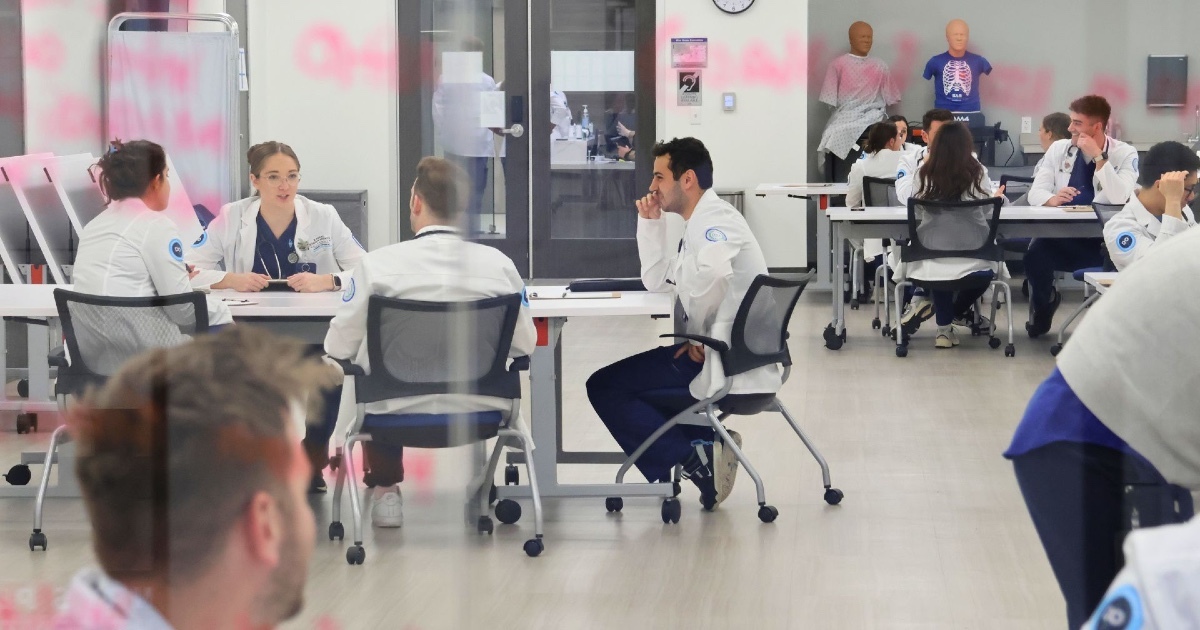
As artificial intelligence becomes a routine part of health care, KansasCOM faculty are rethinking how medical students learn to reason through uncertainty, evaluate information, and maintain meaningful patient relationships.
In the emergency room, Angela Carrick, DO, doesn’t hesitate to consult artificial intelligence. Between patients, she uses it to review medications and scan the latest clinical guidance in seconds.
If you ask physician-educators like Dr. Carrick and her colleagues, who divide their time between the clinic and the classroom at the Kansas College of Osteopathic Medicine, AI is part of daily clinical decisions and is redefining how future physicians are trained.
“I use AI frequently in the ER,” says Dr. Carrick, associate dean of Pre-Clinical Professional Education and Experiences and associate professor of Emergency Medicine.
Alongside Dr. Carrick, KansasCOM clinical faculty Mark Mosley, MD, and Joshua Davis, MD, have been examining what AI adoption means for medical education. In a 2025 presentation at Rush University, “Rewriting the Script: Integrating AI into Teaching Clinical Reasoning in the 21st Century,” the three argued that a physician’s value is not just defined by what they know but also by how they interpret information, apply judgment, and balance technical precision with human care.
At KansasCOM, that perspective shapes how students are trained to engage with emerging technologies like AI, learning how to use them effectively while recognizing their limits in patient care.
The foundation begins in the classroom, where students develop the habits of thinking they will rely on in practice.
Learning to Think Like a Physician—With AI
Traditionally, medical education has emphasized memorization, such as training students to recall diseases, recognize patterns, and work through long lists of possible diagnoses. But faculty say that model alone does not translate cleanly to real-world practice.
“Our medical education system is a bit broken,” Dr. Mosley says. “The only experience students have early on are test questions that ask really rare stuff.”
As a result, students develop a distorted sense of probability, overestimating rare conditions and underestimating common ones because their exposure is shaped more by exams than real-life frequency.
“The clinician has experience as their guardrails,” Dr. Mosley says. “The medical student hasn’t built theirs yet.”
That gap between knowledge and experience is where AI plays a role. Rather than relying solely on memorization, students are learning to think probabilistically: not just what is possible, but what is most likely, what is rare, and what cannot be missed.
In one exercise, students use AI tools to build differential diagnoses for common complaints, such as hip pain. The goal is not only to generate a list, but to rank the likelihood of each condition based on patient history and exam findings, helping students begin to develop the clinical judgment they have not yet had time to build.
“We know students are going to use AI,” Dr. Carrick says. “So, we want to teach them how to use it correctly while they’re under our guidance.”
The goal of the exercise, Dr. Mosley underlines, is to strengthen clinical thinking by having students practice being better interpreters of information.
“In most of our courses, we actually limit AI use,” he says. “Students go into a room with another human being and write down their answers and give the attending a piece of paper. We’ve chosen to force them to do this without cutting and pasting, without creating a template before they ever walk into the room.”
Clinical discernment skills take on new weight when students enter actual clinical environments, where AI is increasingly used and where decisions directly affect patient outcomes.
Applying AI in the Clinic Without Losing Trust
In clinical practice, physicians are integrating AI into how they gather information, review evidence, and support decision-making in real time.
As an example, Dr. Carrick uses the medical AI platform OpenEvidence in the ER as a fast reference tool.
“I use it all the time to double-check my thinking,” she says. “I might ask whether a medication could be causing a side effect or get help working through a differential diagnosis for a patient with a particular set of symptoms. It helps me make sure I’m considering all the possibilities.”
Used this way by an experienced clinician, AI can help confirm treatment plans, identify uncommon side effects, and incorporate the latest research. But faculty are equally clear about the risks for up-and-coming medical trainees.
“One concern is that students may blunt their critical thinking skills,” Dr. Carrick says. “If they rely on it too early, they may not do the reasoning themselves.”
The implications for medical education are growing as AI takes on more documentation. In some settings, systems can record visits and generate SOAP notes, which are organized summaries that capture details from the patient visit and guide next steps in care.
While efficient, Dr. Mosley says this approach encourages disengagement and introduces risks.
“Our electronic charts are AI-guided now,” he says. “When someone comes in with chest pain, it creates a list of 12 possible causes and drops them into the chart, so it looks like I’ve considered all of them. And it’s a problem because you’ve got good people … creating false charts because of AI.”
Faculty emphasize that technology can never replace core elements of clinical care, especially bedside presence. A 2025 article in the New England Journal of Medicine found that medical trainees spend as little as 13% of their time in direct contact with patients.
Less time at the bedside contributes to poorer history-taking, more diagnostic error, higher costs, and a weakening of the doctor-patient relationship. Ultimately, the challenge is not just technological but philosophical.
“We have to ask what health care is,” Dr. Mosley says. “Is it an exchange of a product? Or is it being with another person in their suffering and helping them through it?”
If it is the latter, medical education must ensure AI enhances care without eroding human connection.
As AI impacts real-world decision-making, it is also forcing medical schools to rethink how those decisions, and the human skills behind them, are evaluated.
Balancing Technical Precision and Human Judgment in Simulation
At KansasCOM, the commitment to preserving human connection while integrating AI is reflected in how students are evaluated in simulated clinical environments. Students do not use AI themselves here, but faculty uses the technology to assist in assessment.
In the Tokala Clinical Skills Lab, different evaluators focus on different dimensions of care. AI supports faculty in assessing technical performance, while simulated patients focus on the human side of the interaction.
“LearningSpace is the system we use for videoing and recording student encounters,” says Wendy Garrett, coordinator of the Simulated Patient Program. Through Garrett, KansasCOM has served as a beta tester and early adopter of the platform’s AI-enhanced features, which are now rolled out to all users.
The program analyzes audio to identify key clinical actions and tags those moments for faculty review. In a head-to-toe assessment, students are expected to complete dozens of specific tasks: checking the eyes; examining the head, ears, nose, and throat; listening to lung sounds; palpating the abdomen; and testing strength.
“It recognizes when key events are happening,” Garrett says. “Faculty can jump to specific moments in the video. It tells you, for example, at 6 minutes and 47 seconds, with a two-star confidence level, that the student verbalized as they should.”
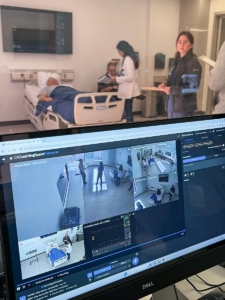
Simulated clinical scenario with trained actors serving as patients, recreating real care situations. Scenarios are recorded and monitored through the LearningSpace platform, visible on screen.
For faculty reviewing large numbers of encounters, the time savings are significant. But while AI can identify what a student does, it cannot interpret how care is experienced. Often labeled as “soft skills,” dimensions of care such as empathy, communication, and attitude remain difficult for AI to parse.
“Soft skills are exactly what our simulated patients zero in on,” Garrett says. “They know if a student is showing compassion. You can feel that.”
Simulated patients evaluate subtleties like tone of voice, body language, whether a student explains what they are doing, and even note small gestures like warming hands before an exam or engaging in brief conversation to break the ice.
That emphasis on the patient experience points to what KansasCOM ultimately prioritizes in training future physicians.
Holding on to What AI Cannot Replace
KansasCOM’s philosophy resists a quiet shift AI enables toward care that is more efficient, yet less present. Students are trained to use AI without giving up their own judgment and to let technology support care without replacing their engagement with patients.
Training future physicians, then, means more than mastering new tools and technologies. It must also stress protecting the human responsibilities that an increasingly complex health care system disincentivizes.