
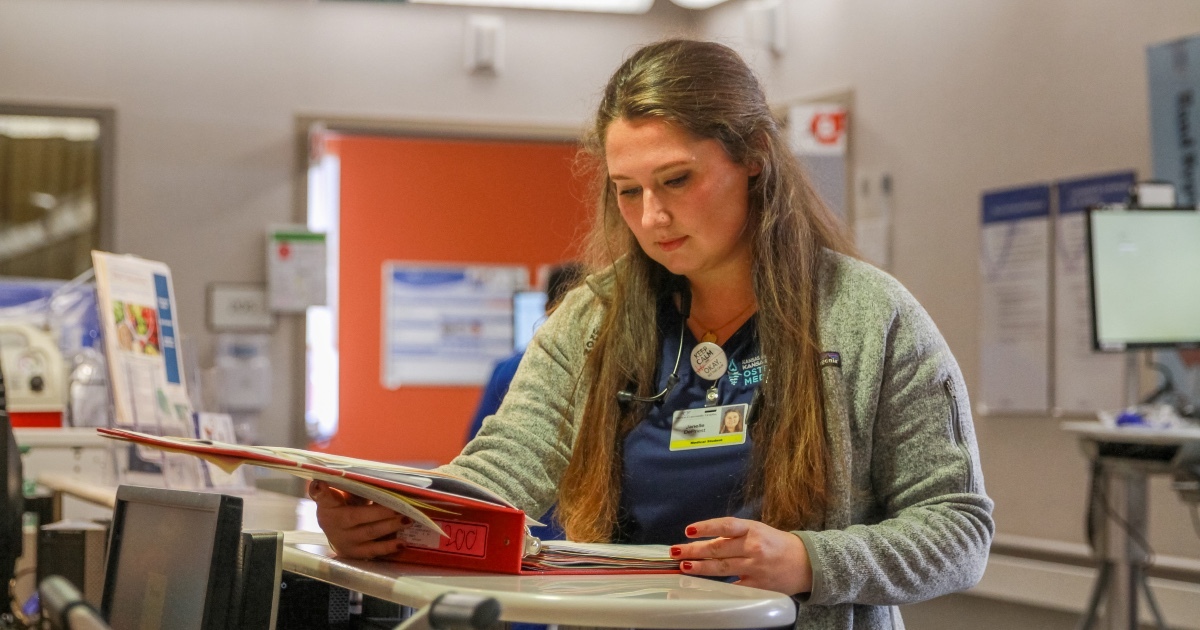
Explore KansasCOM’s DO program: hands-on clinical rotations in rural and urban settings preparing future osteopathic physicians for real-world practice.
Underserved communities face limited access to health care, where routine appointments can require hours of travel and consistent care is harder to find close to home. For patients, these realities make the need for well-prepared, community-minded physicians especially urgent.
At Kansas College of Osteopathic Medicine (KansasCOM), located in Wichita, medical education is designed to meet these real-world needs. Rural health care experiences are a valued part of the Doctor of Osteopathic Medicine curriculum, allowing students to gain real-world exposure that shapes them into capable osteopathic physicians ready to lead.
Real Patients, Real Responsibility
In high-stakes situations, students see how a team stays ready under pressure. They witness clear, thoughtful plans being built in real time and how information moves from person to person.
Understanding each team member’s responsibility strengthens team communication and patient safety. Over time, students begin to anticipate what the team needs, learning when to speak up and how to stay calm. Exposure to these environments prepares them for future leadership roles when they are the ones directing care.
Doctor of Osteopathic Medicine students practice:
- Presenting patient histories and assessments
- Assisting with procedures
- Treatment planning
- Team-based communication
Through repetition and feedback, students build their confidence in patient care and technical knowledge. Each rotation becomes real-world practice for their future career.
By the fourth year, students complete sub-internships where they function at an advanced level. They take on more ownership and manage more day-to-day clinical tasks, with the opportunity to demonstrate the judgment skills that come from earlier community-based rotations.
Mentorship That Makes a Difference
Clinical rotations are where mentorship becomes most visible. At KansasCOM’s rural sites, students work side by side with practicing physicians in smaller care teams that allow for direct teaching, immediate feedback, and meaningful participation in patient care.
These settings create space for consistent interaction. Students are invited into decision-making conversations, guided through procedures, and encouraged to reflect on complex cases in real time.
Blending Compassion With Clinical Judgment
Osteopathic physicians are trained to look beyond symptoms. During one rotation in a small Kansas community, a KansasCOM student observed how his preceptor knew each patient not only by their symptoms but also by their family dynamics, work responsibilities, and daily challenges.
Working side by side with that physician, the student saw how trust is built over time and how strong community relationships shape better care decisions. Conversations extended beyond diagnoses, offering insight into how personal and environmental factors influence health outcomes.
“It was a great example of how important it is to get to know a patient as a human being,” says Dasa Gangadhar, MD, senior associate dean of Curriculum, Clinical Medicine, and GME at KansasCOM.
These relationships influence professional growth. Students observe how mentors balance compassion with clinical judgment. They see how experienced physicians communicate clearly with families and guide teams through challenging cases.
Real-Time Coaching
While much of medicine involves familiar conditions, there are moments when answers are not obvious. In those moments, students learn to rely on collaboration and ethical judgment.
“Ninety percent of what you see may be bread and butter, but 10% of what you see is going to be stumping,” Dr. Gangadhar notes.
Those difficult cases are where mentors make all the difference. Faculty guide students through the gray areas, offering real-time coaching and feedback. Students learn to approach ambiguity and move forward without guessing.
How Mentorship Prepares Future Leaders
KansasCOM also provides opportunities for leadership exploration during fourth-year electives. Students may examine hospital administration, clinical operations, or system-level decision-making.
Faculty guide students through these rotations, allowing them to broaden their understanding of how leadership shapes patient care across settings.
Medicine Rooted in Community
In rural Kansas, medicine is personal. Physicians often create more meaningful relationships with patients, embracing the patient-centered approach. Osteopathic physicians in these communities look beyond symptoms, recognizing the personal and environmental factors that influence a patient’s well-being.
Dr. Gangadhar recalls a KansasCOM student who was doing their clinical rotations in a small Kansas community. The student was struck by how deeply his preceptor knew each patient, acknowledging their families and work lives.
“It was a great example of how important it is to get to know a patient as a human being, and I think that really made an impression on the students,” Dr. Gangadhar shares. “We hear that a lot in these smaller communities.”
Experiences like these reflect the heart of rural medicine. Students see how care extends beyond a single visit, learning how trust builds over time and how strong community relationships can enhance care.
Gaining Clinical Experience in Rural and Urban Settings
During rural rotations, students quickly take on meaningful responsibility, joining care teams where they can present cases and contribute to clinical discussions that directly shape treatment plans.
“Our students rotate both in urban and rural communities,” Dr. Gangadhar says. “Each of those experiences provides its own unique learning experience.” This blend of rural and urban care environments is among the most valuable learning tools for future osteopathic physicians.
In urban settings, students gain experience within large, fast-paced hospital systems, learning to:
- Work alongside subspecialists across a wide range of disciplines
- Observe advanced diagnostics and complex treatment planning
- Collaborate within multidisciplinary teams
- Strengthen their ability to synthesize information quickly in high-volume environments
In rural settings, students develop adaptability by practicing medicine in smaller, resource-conscious environments, learning to:
- Manage a broader range of conditions with fewer specialists available
- Think critically and independently when immediate consultation is limited
- Understand how health care systems function beyond large urban hospitals
- Prepare to serve underserved and marginalized communities with confidence
Building Clinical Adaptability Across Kansas
KansasCOM’s nine clinical rotations provide students with exposure to a wide range of clinical environments, from local clinics to busy hospitals.
“Out in Western Kansas, they may be seeing a disproportionate number of farmers or small business owners,” Dr. Gangadhar says. “The demographics are different in an urban setting such as Wichita. However, each patient population is unique and provides for different but complementary learning opportunities.”
This exposure to various clinical environments strengthens adaptability and problem-solving skills in high-pressure moments.
“The practice in an urban environment is most definitely different, but very complementary to what is gained in a rural environment,” Dr. Gangadhar notes. “So our students have opportunities to experience both.”
Students learn to gather information carefully to develop thoughtful differential diagnoses and adjust when new details emerge. In doing so, they see how preparation and humility work together in patient care.
How Rural Rotations Teach Students to Treat Barriers
Training in rural communities highlights how social and economic factors influence health outcomes.
Patients often face barriers to care, including:
- Transportation limitations
- Limited access to specialty care
- Work schedule constraints
- Child care responsibilities
- Financial strain
Students see firsthand how rural health care requires creativity and advocacy. Treatment plans must account for access challenges, providing patients with the flexibility to align with their personal schedules and goals. That perspective naturally correlates with whole-person medicine, where treatment begins with the individual.
Whole-Person Care in Practice
Osteopathic medicine emphasizes the intricate connection between body, environment, and lived experiences. This perspective involves understanding how a patient lives and how the stressors they carry influence health outcomes.
Students learn the whole-person approach early in their training, and clinical experiences deepen their learning. With patients, they learn to connect physical findings to context, recognizing when conditions relate to barriers such as transportation limitations or chronic stress.
They also witness how strong physician relationships can improve long-term outcomes and support preventative care.
Listening is a key factor in whole-person care. Dr. Gangadhar reminds students that many diagnoses begin with careful attention to a patient’s story. Clinical rotations help students develop the ability to listen and assess early, reinforcing the human-centered foundation of osteopathic training.
“It’s an opportunity for students to see that the vast majority of diagnoses can be made by listening to the patient,” Dr. Gangadhar emphasizes. “It’s the most important part of medicine.”
By learning to listen deeply and think holistically, students strengthen both their diagnostic reasoning and their empathy. Experience with these complex cases helps cultivate physicians who are adaptable and prepared to advocate for patients within the realities of their own communities.
Your Path to Becoming a Doctor of Osteopathic Medicine Starts Here
Medical school is about becoming the kind of physician patients trust in moments that matter. At KansasCOM, clinical education is intentionally designed to accelerate that transformation. Students train in Wichita’s established medical systems while also rotating through rural Kansas communities where physicians serve as frontline decision-makers, advocates, and leaders. This dual exposure develops adaptability, clinical judgment, and professional confidence that carries directly into residency.
Our graduates understand how to function in high-volume hospital systems and how to practice resource-conscious, relationship-driven medicine in smaller communities. They learn when to collaborate, when to lead, and how to think independently when consultation is not immediately available.