
KansasCOM student doctors brought vital women’s health education to young residents at the Sedgwick County Juvenile Detention Facility, creating an open, judgment‑free space for questions. Through the Ark of Hope chapter at KHSU, the volunteers offered guidance and strengthened a growing partnership focused on empowering justice‑involved youth.
The room was quiet at first inside the Sedgwick County Corrections Juvenile Detention Facility. Then the Kansas College of Osteopathic Medicine students began their women’s health presentation, and the young female residents slowly leaned in to ask questions they had never felt comfortable voicing. Through the Ark of Hope chapter at Kansas Health Science University, the student doctors offered guidance on menstrual health, contraception, cancer awareness, boundaries, self-advocacy, and more.
The “Understanding Women’s Health” session began as an idea from second-year student doctor Mannat Narang from Clarksville, Maryland, whose long-standing interest in women’s health continues to guide her career plans. She says she hopes to pursue obstetrics and gynecology, and possibly gynecologic oncology. Her undergraduate major in gender studies shaped much of that passion, along with her research experiences.
During her senior year, Narang explored several public‑health topics, including how certain chronic conditions intersect with mental well‑being. She also examined the persistently high maternal mortality rates among Black women, a group that continues to experience disproportionate risks during pregnancy.
A summer public health research project at Johns Hopkins helped sharpen her interest in women’s cancer prevention, specifically ovarian cancer.
“We came up with a bookmark-style resource that went over the advantages of getting your fallopian tubes removed in the hopes of preventing ovarian cancer in the future,” she says. “At this point ovarian cancer is still on the rise, but there is no screening for it. That’s why it is hard to really prevent ovarian cancer if there is no screening such as prostate cancer screening or Pap smears for cervical cancer.”
Realizing how many adolescents grow up without basic women’s health education pushed her to create a session that addressed those gaps. Through KHSU’s Community Engagement Specialist, the Ark of Hope group became connected with the detention facility. Narang and her fellow KansasCOM volunteers designed the presentation and prepared the lesson.
Student Doctors Draw on Their Own Experiences
A familiar feeling settled in for many of the KansasCOM volunteers, who remembered navigating adolescence without clear sexual health education. With only five residents in the room, ages 12 to 16, the session became a personal conversation on top of the formal lesson.
Second-year student doctor Morgan Trapp of Wichita says her personal background made this work especially meaningful. She plans to pursue obstetrics and gynecology.
“I grew up with a single dad and so I did not get any feminine hygiene education,” Trapp says. “I just did not know about it. So, I was passionate about bringing it to girls who may have been in the same situation.”
She says having two children in the past three years gave her an even clearer sense of the kind of provider she hopes to become.
“I think having those experiences informed me a lot. I really love some of the care that I received and, some of it, I did not,” she says. “I want to be a good provider to other women that may be going through the same thing.”
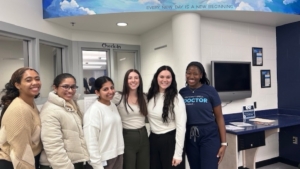
Six first‑ and second‑year KansasCOM student doctors led the Ark of Hope women’s health session at the Sedgwick County Juvenile Detention Facility
Six first‑ and second‑year KansasCOM student doctors led the Ark of Hope women’s health session at the Sedgwick County Juvenile Detention Facility
The residents proved eager to ask questions, including about using menstrual cups and increasingly popular oral contraceptives. Conversation moved from proper tampon usage to ovarian cancer risk, to what healthy boundaries look like in relationships both in-person and online.
Another second‑year student doctor, Celine Wetiba of Wichita, is considering a specialty in family medicine or pediatrics. She says her gap year in urgent and primary care, along with her time as a youth leader in her church, shaped her approach to connecting with the girls.
“Being close in age with them, hopefully they can see us and know that if it is okay for us to talk about these stigmatized topics, it is okay for them to talk about it with somebody that they trust as well,” Wetiba says.
A Detention Facility Collaboration That Continues to Grow
Sedgwick County Juvenile Detention Senior Independent Living Trainer ShaQiyla Banks oversees weekly programming that includes life skills, social‑emotional lessons, volunteer activities, religious services, and more. She says female‑focused programming is somewhat limited, so they were excited about the Ark of Hope women’s health session.
Banks says many teens told her they do not have sexual wellness conversations at home, and the presence of student doctors made a powerful impression.
“KansasCOM students provide a different perspective for our kids,” Banks says. “Just seeing young people in the medical field, I believe that their presence alone can spark the minds of our youth.”
KansasCOM’s involvement at the detention facility extends beyond women’s health education. Medical students have participated in several activities with the facility over the years, including a Halloween event last year that Banks says had a major positive impact on all the residents. And a recent anatomy lesson with hands-on learning activities allowed the residents to explore body systems in an accessible way. Student volunteers have also donated feminine hygiene products, meeting a vital need.
Banks says she hopes KansasCOM volunteers recognize the value of what they brought to the classroom. Their presence gave the girls great information and the confidence to keep asking questions.
The experience shaped the student doctors, too. They left with a renewed sense that osteopathic care begins with connection as much as clinical skill.
This outreach is supported in part by Bank of America, whose investment helps to fund KHSU’s Community Engagement Specialist and expand programs that connect student doctors with meaningful service opportunities like this one.