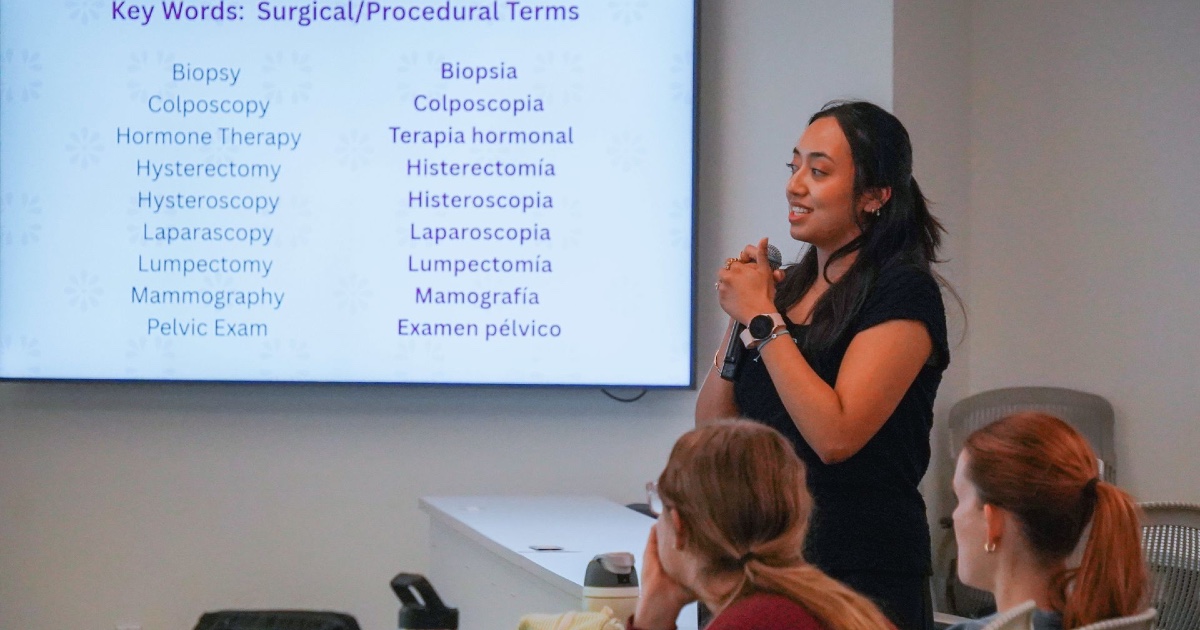
Members of KansasCOM’s Latino Medical Student Association use medical Spanish workshops to explore how language influences trust, communication, and patient care.
BY GIBSON COMBS
Growing up, first-year medical student Jennifer Agostadero watched her bilingual pediatrician communicate directly with her Spanish-speaking mother. Years later, after shadowing that same physician, she is preparing for her own future career in pediatrics at KansasCOM. Seeing how shared language strengthened trust between her doctor and family shaped how she thinks about the care she hopes to provide one day.
“In pediatrics, it’s so important to connect with the [patients’] parents,” Agostadero says. “For my mom, that was important. That way she was be able to understand for sure what was going on and how to be involved.”
Along with fellow members of the Latino Medical Student Association (LMSA), Agostadero helps develop and lead medical Spanish workshops open to all student doctors. The sessions focus on more than vocabulary, encouraging students to think about how language shapes the patient experience.
Building Trust Through Language
Students involved with LMSA say speaking a patient’s preferred language can strengthen physician-patient relationships in meaningful ways.
Second-year student doctor Carlos Talledo saw that benefit himself while working as a clinical research coordinator in Florida. Serving as a translator for a monolingual physician and working alongside a bilingual physician, he observed how language could change a patient’s experience even when the medical treatment was the same.
In cases involving sensitive procedures, communication often became more complicated when interpretation was required.
“The physician sometimes has to communicate with the patient mid-procedure,” he says. “It was very difficult for our non-bilingual provider to relay those instructions, and sometimes there’d be frustration on both sides. As the translator, I would have to be behind a curtain, so sometimes patients couldn’t hear me, and there was this more complicated process. As opposed to when our bilingual physician did the procedure, she was able to communicate a lot more comfortably with the patient.”
First-year student doctor Sofia Ramirez has seen similar moments. Before coming to KansasCOM, she worked with underserved patients through community clinics in Florida. One interaction with a Spanish-speaking patient has stayed with her.
“We had a patient that came in, and he was very, very down, but was not really communicating much. Only short, one-word answers: ‘yes’, ‘no,’” she says.
Then Ramirez shifted the conversation to Spanish.
“He let go of all of those worries because he knew that somebody understood him and could relate to him,” Ramirez says. “He told me his whole story about how he came from Mexico and he missed his family and how he was feeling about that. Language does a lot more than just literally translate.”
Experiences like these are part of the reason LMSA members are eager to share their language skills with classmates.
More Than Vocabulary
LMSA hosts regular medical Spanish sessions designed to be approachable for students at all levels of experience. During the workshops, students practice medical terminology and pronunciation through guided conversations and exercises.
As LMSA president Isabel Ramos explains, the goal is not perfection. “Don’t be scared to make a mistake or to sound unprofessional,” she says. “If you’re trying your best, whoever you’re talking to will get the gist of what you’re trying to say. It shows an initiative that maybe some other providers don’t have.”
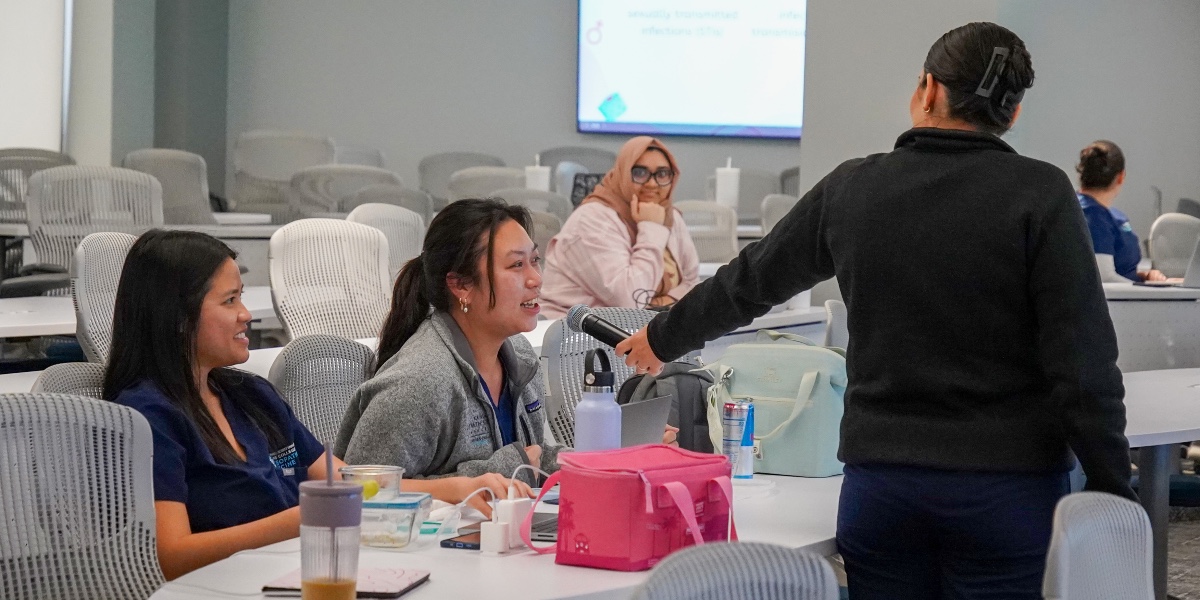
Isabel Ramos holds a microphone for a student during a medical Spanish workshop. The sessions help students practice medical terminology and pronunciation
As a Mexican American and Cuban American, respectively, Agostadero and Ramirez bring different perspectives to the development of the Spanish lessons. The sessions incorporate regional differences in vocabulary and expression while emphasizing the broader role language plays in patient care.
“I wanted to bring that aspect into the teaching that was not just vocab, but also an understanding of why it’s important,” Ramirez says.
While interpreters and translation tools are useful, LMSA members say those resources cannot fully replace the cultural or nuanced understanding that can develop through direct conversation with the doctor.
“As long as patients know that you’re trying to understand them, trying to communicate with them, and empathizing with them on another level, I think that’s going to bridge gaps in care,” she says.
Translating Learning into Community Care
While some might associate language barriers with larger metropolitan areas, LMSA members point out that Spanish-speaking communities can be found throughout Kansas, and here in Wichita.
According to Census data, Spanish is the most spoken non-English language in Kansas households, and eight percent of households report Spanish as the primary language spoken at home.
“You have these pockets in Kansas that we don’t unfortunately pay that much attention to, and they deserve quality care as well,” Ramirez says.
The importance of language-concordant care is also reflected in research conducted by KansasCOM students. In a recent study of 13 Spanish-speaking patients in rural Kansas ranging in age from 18 to 85, all participants said they preferred receiving care in Spanish. Nearly three-quarters reported challenges understanding their treatment plans because of language barriers, and nearly three-quarters believed language barriers had contributed to medical errors or miscommunication. These findings suggest that language barriers can affect patients’ ability to understand care instructions and remain engaged in their healthcare.
The study was presented by former LMSA president and third-year student Monika Nikicicz at the LMSA Midwest Regional Conference in Milwaukee, Wisconsin, connecting the group’s focus on medical Spanish education with research into patient experiences across Kansas.
In addition to the workshops, LMSA members also volunteer at the Guadalupe Clinic, a Wichita nonprofit that provides free healthcare services to uninsured patients. With 75% of the clinic’s patients identifying as Hispanic, students can see the value of shared language in practice.
Ramos says, “All of their staff speak Spanish. And I know with some of their volunteer opportunities, you don’t have to speak Spanish yourself, but I think it’s another really good way to get immersed into medical Spanish.”
Medical Spanish is not part of KansasCOM’s curriculum, but students continue showing up to sessions to learn from one another. Over time, the lessons can shape how they connect with patients.
Ramos says language can help break down the distrust some patients feel toward the healthcare system.
“Being able to create that familiarity reinforces the trust,” she says. “And they’re more likely to follow their treatment plan because they know you’re there to support them.”
While preparing for careers in osteopathic medicine, these LMSA members see language as one more clinical skill. They believe that a shared language can help patients and their families feel understood when discussing a diagnosis, asking questions, or sharing their stories.